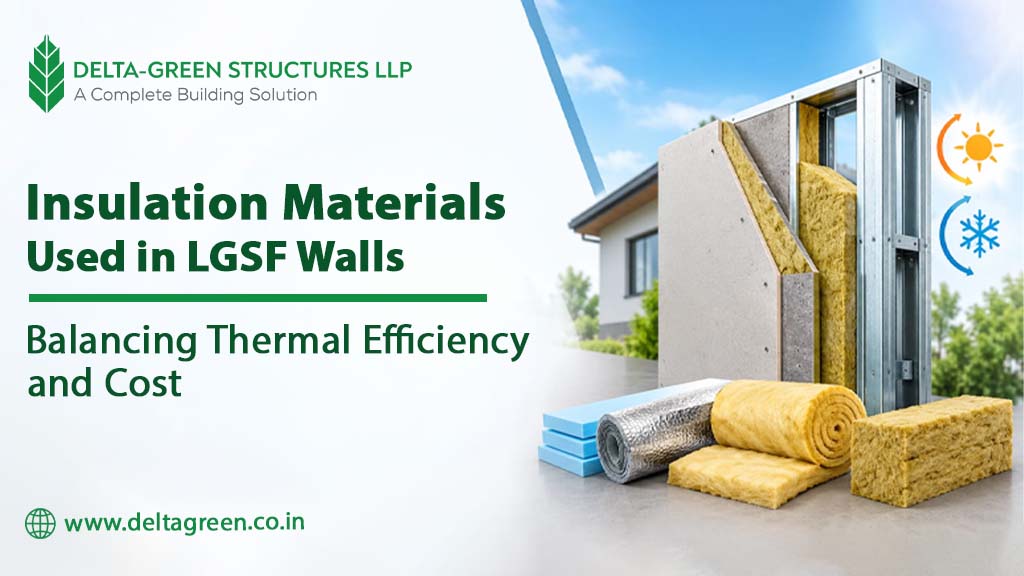
Insulation Materials Used in LGSF Walls: Balancing Thermal Efficiency and Cost
The Right Insulation Makes Every Wall Work Smarter
A well-designed building should do more than provide shelter. It should maintain comfortable indoor temperatures, reduce outside noise, and help control energy consumption without making construction unnecessarily expensive. In Light Gauge Steel Framing (LGSF), achieving these goals depends heavily on the insulation selected for the walls.
Insulation Materials Used in LGSF Walls play a crucial role in determining a building’s thermal performance, acoustic comfort, moisture behaviour, and long-term operating costs. However, choosing insulation based on price alone can lead to higher energy bills or performance issues later.
The real challenge is finding the right balance between upfront investment, insulation efficiency, installation quality, and long-term value. Understanding how different materials perform makes that decision much easier.
What Makes LGSF Wall Insulation Different?
LGSF construction uses lightweight, cold-formed steel sections to create a building’s structural framework. The system offers advantages such as dimensional accuracy, faster assembly, and reduced construction waste when properly planned.
However, steel conducts heat much more readily than conventional insulating materials. Heat can travel through steel studs even when insulation fills the spaces between them. This phenomenon, known as thermal bridging, can reduce the overall thermal performance of a wall.
That is why effective Light Gauge Steel Framing insulation requires more than simply filling the wall cavity. Designers must consider the insulation material, steel stud arrangement, continuous insulation layers, air leakage, vapour control, and local climate.
A carefully designed wall assembly can improve comfort and reduce unwanted heat transfer without compromising the benefits of LGSF construction.
1. Glass Wool: Affordable and Effective for Everyday Applications
Glass wool, also called fibreglass insulation, is manufactured from fine glass fibres that trap pockets of air. It is widely used in residential, commercial, and lightweight steel-framed buildings.
Why choose glass wool?
- Thermal efficiency: Its trapped air helps slow heat transfer through insulated wall cavities.
- Acoustic performance: The fibrous structure absorbs sound.
- Cost considerations: It is often an economical option where locally available products meet the project’s performance requirements.
- Installation flexibility: Batts and rolls can fit between steel framing members when correctly sized and installed.
Glass wool is particularly useful when a project requires a practical balance between thermal performance and budget.
However, gaps, compression, and poorly fitted sections can reduce its effectiveness. It must also be protected from persistent moisture, and installers should use suitable protective equipment because loose fibres can irritate the skin, eyes, and respiratory tract.
Best suited for: Budget-conscious homes, offices, and roof partitions requiring thermal and acoustic insulation.
2. Rock Wool: Strong Thermal, Acoustic, and Fire Performance
Rock wool, also known as mineral wool, is produced from mineral or rock-based fibres. It is valued for its thermal insulation, sound absorption, and fire-resistant characteristics.
Its principal advantage is versatility. Properly specified mineral wool can help limit heat transfer, reduce airborne sound transmission within a suitable wall assembly, and contribute to fire safety.
Many mineral wool products are non-combustible, although the complete wall system must still meet applicable fire-resistance requirements.
From a cost perspective, rock wool may have a higher initial price than some glass wool products. Nevertheless, its acoustic benefits and fire-related properties can make it a worthwhile choice for buildings with demanding performance requirements.
Installation remains important. The product density, thickness, joint detailing, and compatibility with the wall assembly should match the project’s specifications.
Best suited for: Commercial buildings, offices, multi-occupancy developments, and projects prioritising acoustic comfort and fire safety.
3. Expanded Polystyrene (EPS): Lightweight Insulation on a Budget
Expanded polystyrene is a lightweight, rigid foam insulation commonly used in building envelopes. It can provide useful thermal resistance without adding substantial weight to the structure.
EPS is often considered when controlling material costs is important. Its performance depends on the selected product’s declared thermal conductivity, thickness, and installation method.
Compared with fibrous insulation, rigid EPS boards can be useful where a continuous insulation layer is needed outside the steel framing. Such an arrangement may help reduce thermal bridging when designed with appropriate joint and fixing details.
However, EPS is combustible and must be incorporated into a compliant wall system with the required protective layers and fire-safety detailing. Water management, compatibility with adjacent materials, and local building regulations must also be considered.
Best suited for: Projects requiring lightweight rigid insulation and a carefully detailed external insulation layer.
4. Polyisocyanurate (PIR): More Insulation in Less Space
Polyisocyanurate, commonly called PIR, is a rigid foam insulation used where high thermal resistance and limited wall thickness are important.
Its relatively low thermal conductivity can allow designers to achieve a target insulation performance with less thickness than certain alternative products. This can be particularly useful when internal floor area, façade depth, or architectural detailing restricts available space.
PIR boards are often more expensive than basic fibrous insulation. However, the additional cost may be justified when space efficiency is a priority.
Performance should be assessed using the product’s declared thermal conductivity, thickness, temperature conditions, and relevant long-term design values. Fire behaviour also varies by product and complete wall construction, so compliant protective detailing is essential.
Best suited for: Space-constrained projects, selected commercial buildings, and applications requiring high thermal resistance within a limited wall depth.
Comparing LGSF Wall Insulation Materials
The following comparison provides a practical starting point. Actual costs and performance vary by manufacturer, product specification, thickness, and location.
Material | Main advantage | Relative upfront cost | Important consideration |
Glass wool | Economical thermal and acoustic performance | Low to moderate | Requires accurate fitting and moisture protection |
Rock wool | Acoustic performance and fire-related benefits | Moderate | Specify suitable density and thickness |
EPS | Lightweight rigid insulation | Low to moderate | Requires appropriate fire and moisture detailing |
PIR | High thermal resistance per unit thickness | Moderate to high | Higher initial cost and careful fire detailing |
Rather than choosing a material solely by its price per square metre, compare the installed cost of a complete wall assembly that meets the same thermal, acoustic, moisture, and fire-performance targets.
How to Balance Thermal Efficiency and Cost
The most economical insulation is not necessarily the one with the lowest purchase price. A better decision considers the total cost of construction and building operation.
1. Compare Thermal Performance at the Required Thickness
Thermal conductivity, expressed in W/m·K, indicates how readily a material conducts heat. Lower values generally mean better insulating performance for the same thickness.
Thermal resistance, or R-value, increases with thickness and depends on the material’s conductivity. However, the effective performance of an LGSF wall also depends on steel studs, fixings, air gaps, and other wall layers.
Always compare complete wall assemblies rather than insulation products in isolation.
2. Account for Thermal Bridging
Steel studs can create pathways for heat flow through an otherwise insulated wall. Continuous insulation across the framing can reduce this effect.
Depending on the design, combining cavity insulation with a suitable external insulation layer may deliver better results than increasing cavity insulation alone. The additional material cost should be compared against the improvement in overall wall performance.
3. Consider the Local Climate
A building in a hot climate may need to limit unwanted heat gain, while a cold-climate project must also control heat loss. Humid regions introduce additional moisture-management challenges.
For projects in humid parts of Northeast India, including areas around Siliguri, designers should assess monsoon exposure, driving rain, indoor humidity, ventilation, and drying potential. A suitable weather barrier, drainage strategy, sealed penetrations, and correctly designed vapour-control layers are essential.
The appropriate vapour-control arrangement depends on climate, air-conditioning patterns, and the complete wall build-up. A universal solution does not suit every building.
4. Calculate Long-Term Value
Consider installation labour, maintenance, energy consumption, expected service life, and replacement costs alongside the initial material price.
A more expensive insulation product may be worthwhile when it delivers a meaningful improvement in performance. Equally, a lower-cost material may be the smarter choice when it satisfies all project requirements without unnecessary upgrades.
Don't Overlook LGSF Acoustic Insulation
Thermal comfort is only one part of a successful building. Road traffic, neighbouring rooms, office conversations, and mechanical equipment can all affect indoor comfort.
LGSF acoustic insulation depends on the combined performance of the insulation, wall linings, framing, cavity depth, and junction details. Fibrous materials such as glass wool and rock wool can absorb sound within wall cavities, but insulation alone does not guarantee soundproofing.
For better results, designers may combine cavity insulation with multiple layers of plasterboard, resilient channels, sealed perimeter joints, and carefully detailed service penetrations.
The correct solution depends on the required sound reduction and the frequencies involved.
Why Professional Wall Design Matters
Selecting insulation is only one step in creating an efficient LGSF building. The entire assembly must work together, from structural steel and insulation thickness to external cladding, weather protection, internal lining, and ventilation.
Delta Green Structures brings LGSF manufacturing capabilities and turnkey construction services together, using automated Pinnacle machines and a focus on precision, quality materials, and efficient project delivery.
For each project, the right approach is to assess the building’s location, intended use, thermal targets, acoustic needs, fire requirements, and budget before finalising the insulation specification.
This helps avoid unnecessary material expenditure while ensuring that the selected wall system is appropriate for its intended application.
Conclusion: Invest in Performance, Not Just Materials
The best Insulation Materials Used in LGSF Walls are those that meet a building’s performance requirements at a sensible overall cost.
Glass wool can offer an economical balance of thermal and acoustic performance. Rock wool provides valuable acoustic and fire-related benefits. EPS can serve as a lightweight rigid insulation option, while PIR is worth considering when high thermal resistance and limited thickness are important.
Ultimately, successful Light Gauge Steel Framing insulation depends on more than the product itself. Thermal bridging, moisture control, installation quality, climate, and the complete wall assembly all influence the result.
With careful planning and the right technical guidance, Delta Green Structures can help project owners explore LGSF solutions that balance construction efficiency, indoor comfort, and long-term value. The goal is not simply to insulate a wall, but to create a building envelope that performs reliably for years to come.