
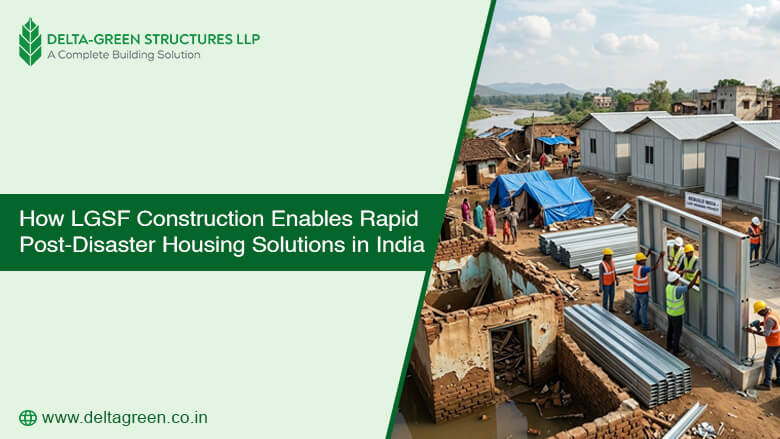
How LGSF Construction Enables Rapid Post-Disaster Housing Solutions in India
Natural disasters strike without warning. From devastating floods in Assam to powerful earthquakes in Himalayan regions and cyclones along India’s eastern coastline, disasters leave thousands of families without shelter overnight. In these critical moments, the biggest challenge is not just rescue — it is rebuilding homes quickly, safely, and sustainably.
This is where LGSF construction for post-disaster housing in India is transforming the way recovery and reconstruction happen. Modern Light Gauge Steel Frame (LGSF) technology is helping governments, relief organizations, and construction companies deliver rapid post-disaster housing solutions in India that are durable, cost-effective, and ready in a fraction of the time compared to traditional construction.
Delta Green Structures are at the forefront of this transformation, using advanced LGSF technology and precision manufacturing to create homes that help communities recover faster after disasters.
The Urgent Need for Rapid Post-Disaster Housing in India
India faces frequent natural disasters due to its diverse geography and climate conditions. Earthquakes in the Himalayan belt, floods in the Northeast, landslides in hilly regions, and cyclones along coastal areas often destroy thousands of homes within hours.
Traditional brick-and-cement construction struggles to respond to such emergencies because it requires:
- Long construction timelines
- Large labor forces
- Weather-dependent building processes
- Significant material transportation
These limitations make it difficult to deliver emergency housing solutions after natural disasters when people urgently need shelter.
This is why experts are increasingly turning toward LGSF construction technology in India — a modern approach designed for speed, durability, and efficiency.
What is LGSF Construction?
Light Gauge Steel Frame construction is a modern prefabricated building system where structures are made using cold-formed galvanized steel sections.
Instead of constructing everything on-site, the building components are precision-engineered in factories using automated machines. These components are then transported to the site and assembled quickly.
This method of prefabricated steel frame construction significantly reduces construction time while maintaining structural strength.
At Delta Green Structures, advanced automated manufacturing systems are used to produce high-precision LGSF components that enable faster project completion without compromising quality.
Why LGSF is Ideal for Post-Disaster Housing
When rebuilding communities after disasters, speed alone is not enough. The houses must also be safe, resilient, and sustainable.
1. Faster Construction for Immediate Shelter
One of the biggest advantages of LGSF construction for post-disaster housing in India is its rapid installation.
Since most structural components are prefabricated in factories, onsite construction mainly involves assembling pre-designed frames.
This enables:
- Houses to be constructed in weeks instead of months
- Faster relocation of displaced families
- Quick execution of disaster relief housing projects in India
Such fast-track construction technology in India can dramatically reduce the time people spend living in temporary camps.
2. Earthquake-Resistant Structures
Many disaster-prone regions in India fall within high seismic zones. Conventional masonry structures are often vulnerable to earthquakes.
However, earthquake-resistant LGSF buildings offer superior safety due to:
- Flexible steel framing
- Lightweight structural design
- Even load distribution
Steel structures absorb seismic energy better, making them highly suitable for disaster-resistant housing in India.
3. Flood-Resistant Construction
Floods regularly affect large parts of India, especially in the Northeast and river basin regions.
LGSF structures provide effective flood-resistant housing construction in India because:
- Steel does not absorb water like traditional materials
- Elevated modular designs can reduce flood impact
- Materials resist warping and deterioration
This makes light gauge steel frame buildings ideal for rebuilding homes in flood-prone areas.
4. Modular and Scalable Housing
Another major benefit of LGSF technology is its flexibility.
Modular housing solutions in India allow homes to be designed in standardized modules that can be expanded later as families rebuild their lives.
This approach enables governments and developers to create:
- Temporary relief housing
- Permanent residential units
- Community infrastructure like schools and clinics
With LGSF, entire communities can be reconstructed using efficient modular designs.
5. Cost-Effective Reconstruction
Budget constraints often delay reconstruction after disasters.
However, cost-effective post-disaster housing can be achieved using LGSF due to:
- Reduced construction time
- Lower labor costs
- Minimal material wastage
- Long-term durability
These benefits make LGSF highly suitable for government disaster housing schemes in India, where efficiency and scalability are critical.
6. Sustainable Post-Disaster Reconstruction
Modern disaster recovery must also consider environmental sustainability.
LGSF technology supports sustainable post-disaster reconstruction through:
- Recyclable steel materials
- Reduced construction waste
- Energy-efficient building designs
- Minimal environmental impact
Compared to traditional construction methods, LGSF structures are significantly more eco-friendly.
Supporting Government Disaster Recovery Programs
India has several initiatives aimed at rebuilding homes after disasters, including rural housing programs and emergency relief projects.
The use of modern construction methods for disaster recovery like LGSF can significantly enhance the efficiency of these programs by enabling faster project completion and improved structural safety.
With the increasing demand for disaster relief housing projects in India, innovative technologies are becoming essential for large-scale reconstruction.
Organizations with advanced infrastructure and expertise — such as Delta Green Structures — play an important role in supporting these initiatives by providing end-to-end LGSF building solutions.
The Future of Disaster-Resilient Housing in India
As climate change increases the frequency and intensity of natural disasters, India must adopt construction technologies that prioritize speed, resilience, and sustainability.
LGSF construction for post-disaster housing in India is emerging as one of the most reliable solutions to address these challenges.
With benefits such as rapid construction, structural strength, environmental sustainability, and cost efficiency, LGSF is redefining how communities rebuild after disasters.
Companies like Delta Green Structures, equipped with cutting-edge manufacturing technology and expertise in challenging climatic conditions, are helping bring this modern construction revolution to reality.
Rebuilding Hope Through Smarter Construction
Every disaster leaves behind stories of loss but also opportunities to rebuild stronger. By adopting fast-track construction technology in India, disaster-prone communities can recover faster and build homes that are safer for the future.
LGSF construction technology in India is not just about building structures. It is about restoring stability, dignity, and hope for families who have lost everything. With innovative companies such as Delta Green Structures leading the way, the future of rapid post-disaster housing solutions in India is becoming faster, safer, and more resilient than ever before.