
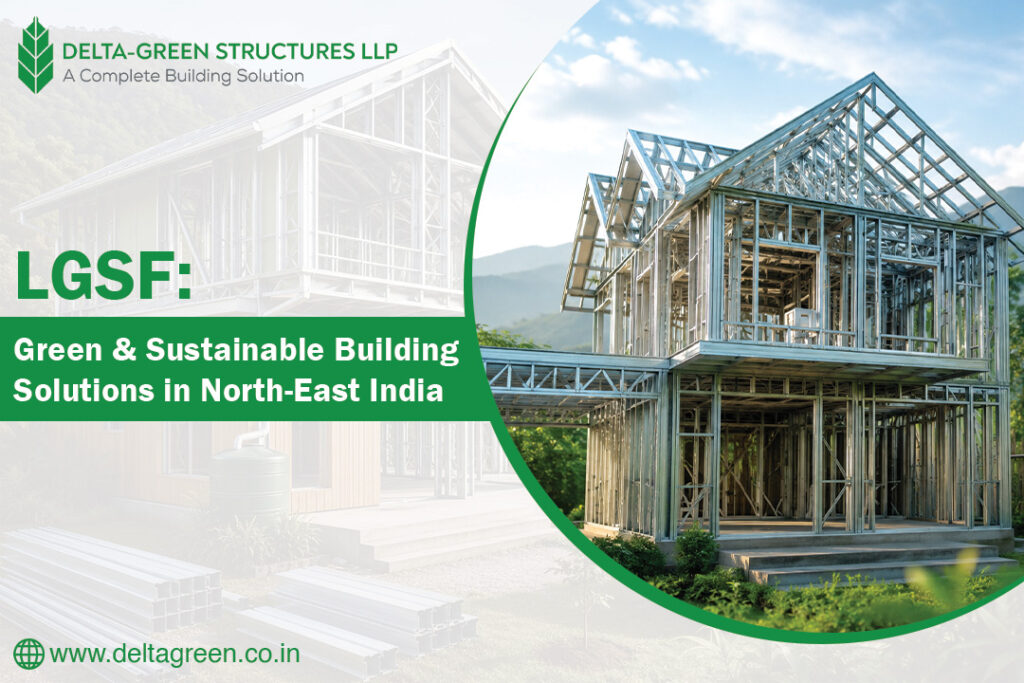
LGSF: Green & Sustainable Building Solutions in North-East India
Steel that speaks. Structures that last. The mountains tested it. The earthquakes challenged it. LGSF passed every time.
Construction in North-East India has always come with unique challenges. Difficult terrain. Extreme weather. High seismic activity. Frequent floods and landslides. These are the conditions where traditional building techniques fall short, due to their high expenses, lengthy construction times, and limited durability.
There is a better way to construct. It is known as Light Gauge Steel Framing -and it is changing the way North-East India builds.
Why LGSF is a Sustainable Building Solution
Galvalume coating, combined with 55% Aluminium, 43.4% Zinc, 1.6% Silicon are one of the most widely used recycled materials in the building lifecycle. It reduces the environmental impact throughout the lifecycle. It has certain unique features such as :
- Less construction waste
- Faster project completion
- Energy-efficient structures
- Recyclable steel materials
- Lower maintenance costs
- Reduced environmental impact
LGSF buildings are designed to last longer while consuming fewer natural resources compared to traditional construction methods.
Why North-East India Needs LGSF Right Now?
If the ground is shaking, your building should not. North-East India is one of the most seismically active regions of India. The area has undulating topography, unreliable weather, and high costs and long delivery times for bringing heavy construction material.
The conventional RCC construction method is weighty. It is a heavy material that uses lots of cement, sand and water. It takes months or years to do. A heavy RCC structure is also at high risk in an earthquake-prone area.
LGSF’s lightweight steel structural system provides complete solutions to all these problems.
Green Building Benefits of LGSF in North-East India
LGSF uses recycled material, Galvalume coating so it leaves a far smaller footprint on the region’s fragile ecosystems. It needs no river sand, no curing water, and generates almost zero construction waste on site.
1. Lower Environmental Impact
Construction causes nearly 40% of global carbon emissions. LGSF helps because:
- No river sand mining is needed (unlike concrete)
- No water is required for curing
- Minimal waste is generated on-site
- Steel is the world’s most recycled material
This protects rivers, forests, and biodiversity -all of which are critical in this region.
2. Earthquake Resilience
The 1950 Assam earthquake measured 8.6 on the Richter scale -one of the strongest ever recorded. The threat has not gone away.
LGSF buildings handle earthquakes better because:
- Steel absorbs and releases seismic energy safely
- Lighter buildings generate less force during a quake
- All joints are engineered and tested -no guesswork
This is not a minor advantage. It is a life-safety issue for millions of people across the region.
3. Flood and Moisture Resistance
Mawsynram in Meghalaya is considered to be the wettest place on Earth. Much of the North-East gets torrential rainfall every year.
LGSF handles this well:
- Steel does not rot, warp, or swell
- Structures can be elevated easily above flood levels
- The right cladding keeps moisture out completelyNo mould or fungal growth in the wall cavity
4. Faster Construction
Speed matters -especially when infrastructure is urgently needed.
- A typical LGSF building is completed in 4 to 6 months
- An equivalent RCC structure takes 18 to 24 months
- Faster builds mean less site disruption, less noise, and lower costs
For schools, hospitals, and homes, this difference is enormous.
5. Energy Efficiency
LGSF works well with insulation systems like rock wool, glass wool, or EPS panels.
- In the cold highlands of Nagaland, Arunachal, and Mizoram, it keeps the heat in
- In the humid lowlands of Assam and Tripura, it keeps heat out
- This reduces electricity bills and energy consumption year-round
Well-designed LGSF buildings can qualify for GRIHA and IGBC green building ratings in India.
Where Is LGSF Being Used in the North-East?
Homes and Housing
- For affordable homes in remote hilly and tribal areas
- Compatible with PMAY (Pradhan Mantri Awas Yojana)
- It can be manufactured in Siliguri and assembled locally
Schools
- Quick to build, safe in earthquakes
- Designed for natural ventilation and daylight
- Lower running costs for energy
Hospitals and Health Centres
- Dust-free construction is ideal for medical settings
- Fast delivery is critical in underserved areas
- Hygienic and easy to maintain
Government Buildings
- Several state governments are already exploring LGSF
- Compatible with Smart Cities Mission projects
- Suitable for areas with poor road connectivity
Eco-Lodges and Tourism
- Low site impact -ideal near forests and wildlife zones
- Can be clad in bamboo, timber, or stone for a natural look
- Removable and relocatable if needed
Respecting the Region's Cultural Identity
North-East India has a rich tradition of vernacular architecture.
- Assamese Chang Ghars (stilt houses)
- Naga Morung structures
- Mizo Zawlbuk community halls
- Arunachali bamboo homes
LGSF does not replace these traditions. It complements them.
LGSF frames can be clad in bamboo, local stone, timber, or traditional-inspired finishes. The result is a building that looks rooted in the region -but is far safer and more durable.
LGSF and Sustainability -Building for the Future
Green is not just a colour. With LGSF, it is a commitment. Governments, institutions, and private builders are all under increasing pressure to build greener.
The LGSF construction system is inherently sustainable:
- Steel can be recycled and reused at the end of a building’s life
- Factory manufacturing reduces on-site pollution and waste
- Lighter structures require less concrete in foundations -reducing cement consumption
- Energy-efficient wall systems can be integrated into the steel frame
- Faster construction means lower energy use over the build period
For North-East India -a region of extraordinary natural beauty and ecological sensitivity -building sustainably is not just good practice. It is a responsibility.
What makes Delta Green Structures a Sustainable Building Solution in North-East India?
Delta Green Structures LLP provides sustainable building solutions in North-East India. Based in Siliguri, West Bengal, they serve clients across West Bengal, Assam, Sikkim, Tripura, Meghalaya, Mizoram, Manipur, Arunachal Pradesh, Bihar, and even Bhutan.
- End-to-End Service: They handle everything from design, manufacturing and all the way to final handover, maintaining sustainable practices. One team. Zero confusion.
- Sustainable practices: They believe in eco-friendly sustainable practices. They use innovative and recycled solutions that reduce heavy carbon emissions and waste products.
- Certified Quality, Affordable Price: Top-tier LGSF materials, sustainable products, automated Pinnacle machines and the latest design software. Professional quality at practical prices.
- Designed for Tough Conditions: They have constructed housings at an altitude of 14,000 ft. Having experience in challenging terrain and extreme weather allow them to complete projects efficiently in all conditions.
- Clear Process, No Surprises: A four-step process in a transparent way, from the first meeting to project closure. Always knows the score.
Frequently Asked Questions (FAQs)
Q1. Is using LGSF costlier than traditional methods?
Q2. Can multi-storey buildings utilise LGSF?
Q3. Is LGSF suited to the climate of North-East India?
Q4. How long will a building made of LGSF last?
Q5. Is LGSF an environmentally friendly construction technique?
Ready to Build Smarter?
The future of construction in North-East India is lighter, faster, stronger, and greener. Light Gauge Steel Framing is not just a trend -it is the most practical, sustainable, and cost-effective building solution available for this region today.
Whether you are planning a home, a hospital, a school, or a government facility – Delta Green Structures LLP has the expertise, the technology, and the on-ground experience to deliver it right.
Do not settle for slow, heavy, and expensive construction. Built with LGSF. Build with Delta Green Structures LLP.