
Delta Green

Rooftop Solar Mounting

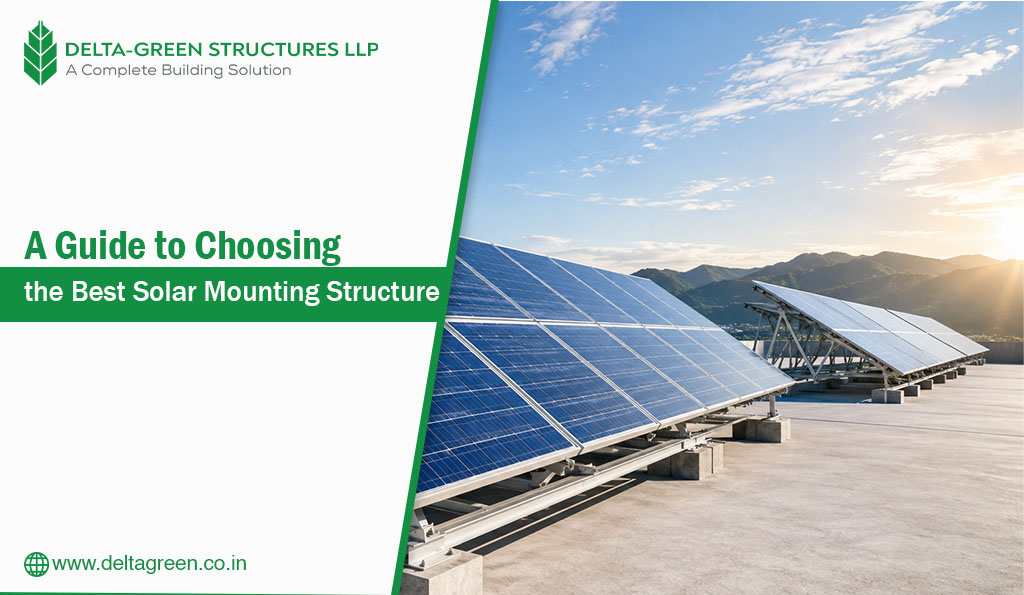
A Guide to Choosing the Best Solar Mounting Structure

A Guide to Choosing the Best Solar Mounting Structure So you’ve decided to go solar. Smart move. But here’s the plot twist nobody talks about at dinner parties – your panels are only as good as what’s holding them up. Pick the wrong Solar Mounting Structure, and you’re looking at rust, wobble, and a support call to your installer within two monsoons. Pick the right one, and your system just… works. Quietly. For decades. This is your no-fluff, fully-loaded guide to finding the Best Solar Mounting Structure for your project – rooftop, ground, or somewhere in between. Why the Mounting Structure Is the Real MVP Everyone obsesses over panel wattage and inverter brands. Meanwhile, the Solar Mounting System – the steel or aluminum skeleton beneath it all – quietly determines whether your investment survives a hailstorm, a cyclone, or just a decade of North-East India’s brutal humidity. Think of it like a bridge. Nobody photographs the foundation, but nobody’s crossing without it either. A poorly engineered Solar Panel Mounting Structure means: Panels shifting out of optimal tilt angle Micro-cracks from vibration Corrosion eating through joints in under five years Higher long-term maintenance costs that quietly kill your ROI At Delta Green Structures, we build LGSF-based Solar Racking Systems engineered for exactly these worst-case scenarios – because “it probably won’t rain that hard” isn’t a design philosophy. Types of Solar Mounting Structures – Pick Your Fighter 1. Rooftop Solar Mounting Perfect for homes, offices, and factories with unused roof space. Rooftop Solar Mounting works great on flat and sloped roofs alike, using lightweight yet rigid frameworks that don’t stress the underlying structure. Best for: Urban homes, commercial buildings, space-constrained sites. 2. Ground-Mounted Solar Structure Got open land? A Ground-Mounted Solar Structure lets you scale big – think solar farms and utility projects – with easier access for cleaning, maintenance, and future expansion. Best for: Solar parks, agricultural land, large industrial campuses. 3. Carport Solar Mounting Two birds, one steel frame. Carport Solar Mounting shades your vehicles while your panels soak up the sun overhead. It’s become the sleeper-hit trend for malls, hospitals, and corporate parks. Best for: Parking lots that are tired of just being parking lots. Fixed Tilt vs. Adjustable – The Eternal Debate Here’s where people overthink it. Fixed Tilt Systems lock your panels at one angle calculated for your location’s average sun exposure – simple, sturdy, budget-friendly. Adjustable systems let you tweak the angle seasonally for marginally better efficiency, but they cost more and need upkeep. Our verdict: Unless you’re running a niche research setup, Fixed Tilt vs Adjustable almost always favors fixed tilt for standard rooftop and ground projects. Less moving parts, less to break. Steel vs. Aluminum Solar Mounting – The Material Showdown This debate gets heated (pun very much intended). Steel: Higher load-bearing capacity More affordable at scale Seriously tough against corrosion Aluminum: Naturally corrosion-resistant Lightweight, easier to transport and install Pricier per unit For Steel vs Aluminum Solar Mounting, the honest answer is: it depends on your site conditions. Coastal or high-humidity zones lean towards aluminum or hot-dip galvanized steel. Inland, high-load projects often go for steel for sheer strength-per-rupee. Delta Green Structures manufactures Solar mounting structures, engineered specifically for challenging terrains – because a generic solution doesn’t cut it in the North-East’s climate. Rooftop vs. Ground-Mounted – Which Wins? Short answer: neither wins universally. Rooftop vs Ground-Mounted comes down to three questions: Do you have unused land, or only roof space? What’s your budget for structural reinforcement? Are you planning future capacity expansion? Rooftop saves land and cuts cabling costs. Ground-mounted offers easier scaling and optimal panel orientation. Either way, the PV Mounting System underneath needs to be engineered – not improvised. What Actually Makes a Mounting Structure Tough Skip the marketing buzzwords. Here’s your real checklist: Weather Resistance – Can it handle heavy rain, high winds, and temperature swings without flinching? Corrosion Resistance – Is it galvanized or coated properly, or will it rust the moment humidity says hello? Long-Term Durability – Will this structure still be standing strong in 25 years, or will you be calling for repairs by year six? Easy Installation – Faster install means lower labor cost and quicker time-to-power. Automated manufacturing (like our Pinnacle machine setup) means precision-cut components that snap together without on-site guesswork. If your Solar Panel Support Structure ticks all four boxes, you’re golden. Why Delta Green Structures Gets This Right We’re the only LGSF manufacturing unit in North-East India offering fully turnkey solar mounting solutions – from design to fabrication to on-ground installation. Every Solar Racking System we build goes through automated precision manufacturing, meaning consistent quality instead of “close enough” tolerances. Delta Green Structures specializes in projects across tricky geographical terrains and extreme climatic zones – which is exactly the environment most generic mounting suppliers aren’t built for. Whether it’s a rooftop residential setup or a large-scale ground-mounted solar park, our team handles the engineering complexity so you don’t have to. The Bottom Line Choosing the Best Solar Mounting Structure isn’t about picking whatever’s cheapest today – it’s about picking what survives the next 25 years of sun, storms, and everything in between. Get the material right, get the tilt right, and get a manufacturer who actually understands your terrain. Ready to build a solar setup that doesn’t need babysitting? Delta Green Structures is one call away.

A Guide to Choosing the Best Solar Mounting Structure Read More »
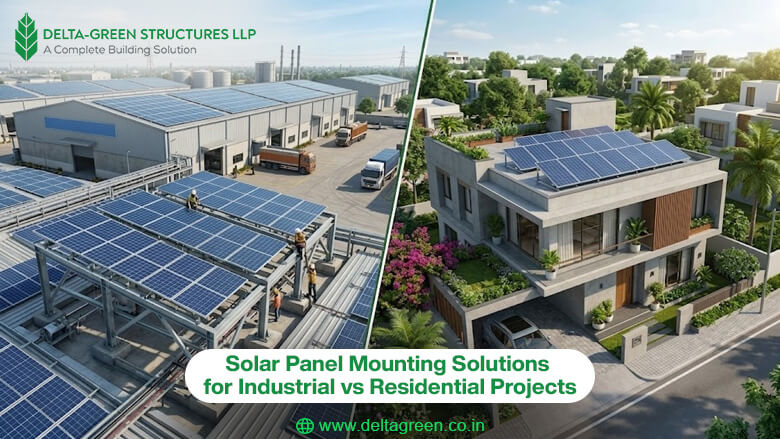
Solar Panel Mounting Solutions for Industrial vs Residential Projects

Solar Panel Mounting Solutions for Industrial vs Residential Projects Same sun. Very different structures. Here’s what you need to know.Solar energy works for everyone – homes, factories, warehouses, and everything in between. But a mounting structure built for a family home is very different from one built for a large industrial plant. Choosing the wrong structure means poor performance, higher costs, and unnecessary repairs down the line. What Is a Solar Panel Mounting Structure? A solar mounting solution is the frame that holds your solar panels in place. It determines:  The angle at which panels face the sun How well they withstand wind, rain, and heat How easy they are to clean and maintain How long does your entire solar system last Get the structure right, and your panels perform at their best – for 25 years or more. Residential Solar Mounting Solutions? Best for: Homes, independent houses, housing societies, small offices Most homes in India have sloped or flat RCC rooftops. Residential solar mounting systems are designed to work with these surfaces without causing damage. Common types used: Sloped roof mounting – panels sit flush along the roof angle using hooks and aluminium rails Flat rooftop mounting – panels are tilted at an optimal angle using a ballasted or anchored frame Small ground mount – used when roof space is limited or shaded Key characteristics of residential structures: Lighter in weight – designed for standard roof load capacity Compact and clean in appearance Easier and faster to install System size typically ranges from 1 kW to 10 kW What matters most for homes: Roof condition and load-bearing capacity Minimal roof penetration to avoid leakage Neat finish that does not affect the look of the home Long-term durability with low maintenance Industrial Solar Mounting Solutions Best for: Factories, warehouses, manufacturing plants, large commercial buildings, solar farms   Industrial projects play a unique game entirely. The scale is larger, the loads are heavier. The structures must perform under far more demanding conditions. Common types used: Large rooftop solar structures – for flat industrial sheds and warehouse rooftops Ground mount solar – for open land adjacent to factories or for utility-scale solar farms Fixed tilt solar structure – the most widely used type for large industrial and utility projects Solar carport structures – for large parking areas within industrial campuses Canal top structures – for industries near irrigation canals or water bodies Key characteristics of industrial structures: Heavy-duty galvanised steel construction for ultimate strength Designed for high wind loads and cyclonic conditions The system is designed for quick and simple large-scale assembly on site Pre-fabrication minimises labour assembly times Typical size is 50kw up to multi-mega watts What matters most for industries: Structural load calculations and wind zone compliance Fast installation to minimise operational disruption Corrosion-resistant materials for long outdoor life Compatibility with large-format solar panels Scalability for future expansion Industrial vs Residential: A Quick Comparison You can just look at the quick comparison table to show what are the basic differences between residential and industrial solar mounting solutions.   Factor Residential Industrial System Size 1 kW – 10 kW 50 kW – several MW Structure Material Aluminium / Light steel Heavy-duty galvanised steel Mounting Type Rooftop (sloped/flat) Rooftop, ground mount, carport Installation Time 1–2 days Days to weeks Load Requirements Standard roof load Heavy structural engineering Maintenance Minimal Scheduled, easy access Cost per Watt Higher (small scale) Lower (bulk, economies of scale) Why the Right Structure Matters A solar panel is only as good as the structure holding it. A poorly designed structure can damage your roof Wrong tilt angles mean less energy generated Inferior materials corrode fast – shortening system life Undersized frames under heavy wind loads can fail entirely Whether it is a small rooftop solar system for a home or a large ground-mount solar farm for an industry, the structure must be engineered for the specific site, load, and weather conditions of that location. What Delta Green Structures Offers Delta Green Structures is a dedicated solar structure manufacturer supplying mounting solutions across India for both residential and industrial projects. They have excelled in delivering effective solutions for both types of projects. For residential projects: Lightweight rooftop frames Clean, minimal design for homes Available for both flat and sloped roofs For industrial projects: Heavy-duty galvanised steel structures Ground mount, rooftop, carport, and canal top options Pre-engineered for wind and load compliance Fast bolt-together assembly for large sites Every structure Delta Green Structures supplies is backed by engineering support, load calculations, and material certifications. Why Choose Delta Green Structures for Solar panel Mounting Solutions? Your panels deserve more than just a frame. They deserve a foundation built to last. At Delta Green Structures, we do not just manufacture solar mounting structures — we engineer long-term performance into every component we produce. Here is why solar developers, contractors, and businesses choose Delta Green Structures: Direct manufacturer – no middlemen, no inflated costs. You get factory-direct pricing with consistent quality every time. Complete range – rooftop, ground mount, fixed tilt, carport, and canal top structures – all under one roof. One supplier for every project needed. Engineered for Indian conditions – designed to withstand heavy monsoons, high winds, coastal humidity, and extreme heat across all Indian climate zones. High-grade materials – hot-dip galvanised steel and aluminium-Zinc alloy frames that resist corrosion and stand strong for 25+ years. Pre-fabricated for speed – bolt-together designs that cut installation time and reduce on-site labour costs significantly. Custom solutions – every project is different. We design structures tailored to your site dimensions, load requirements, and panel specifications. Engineering-backed – load calculations, wind zone compliance, and structural certifications provided with every supply. Frequently Asked Questions (FAQs) Q1. What is the optimal mounting system on the rooftop of the house? Homes are best suited with light steel or sloped roof structures. They are not heavy, will not rust, and will not harm the roof. Q2. What is the structure of large industrial solar projects? The most common type

Solar Panel Mounting Solutions for Industrial vs Residential Projects Read More »