Advantages of Layered Floor Systems in Light Gauge Steel Structures
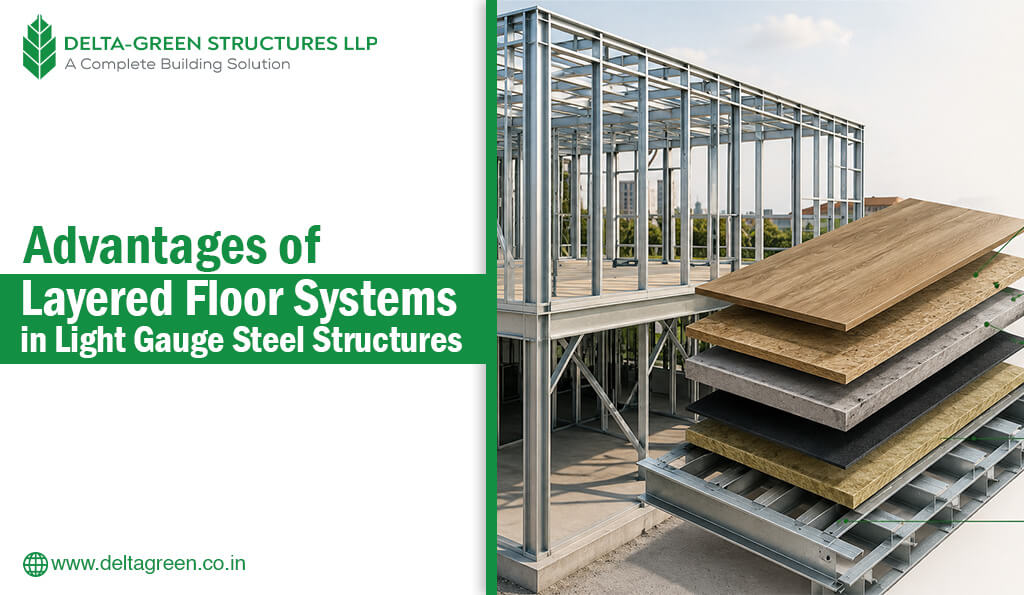
Advantages of Layered Floor Systems in Light Gauge Steel Structures Nobody ever posts a reel about their floor. Ceilings get the spotlight, facades get the “before-after,” and floors just… sit there, silently holding up literally everything. But here’s the plot twist: in Light Gauge Steel Structures, the floor isn’t a passive slab you walk on – it’s an engineered system that decides how quiet, warm, fire-safe, and tough your entire building actually is. At Delta Green Structures, we’ve spent years perfecting Layered Floor Systems in Light Gauge Steel Structures, and honestly, once you understand what’s happening beneath your feet, you’ll never look at “just a floor” the same way again. So, What Exactly Are Layered Floor Systems? Think of it like a club sandwich – but for buildings. Instead of one thick, heavy slab of concrete doing all the work (and taking forever to cure), LGSF Floor Systems stack multiple purpose-built layers on top of a galvanized steel joist framework. Each layer has a job: Structural steel joists – the backbone, engineered for load and span Sub-flooring boards (cement particle boards or calcium silicate boards) – rigidity and walkability Insulation layers – thermal and acoustic performance Finish layer – tiles, vinyl, wood, whatever your interior designer dreams up This is the essence of Composite Floor Systems: multiple materials, each doing what they do best, working together instead of one material trying (and failing) to do everything. Why Are Layered Floor Systems Quietly Winning? Top Advantages 1. Lightweight – Without Being Weak A Light Gauge Steel Floor System can weigh up to 60-70% less than a conventional RCC slab of the same span. Less dead load means smaller foundations, less material, and lower transportation costs. For multi-story builds, this compounding weight-saving is a structural engineer’s dream. 2. Sound Insulation That Actually Works Sound Insulation in layered Steel Floor Systems comes from acoustic mats and resilient layers sandwiched between the steel deck and the finish flooring, absorbing impact noise (footsteps, dropped objects) and airborne noise (voices, music) far more effectively than a bare concrete slab ever could. 3. Thermal Insulation for Every Climate Whether it’s Siliguri’s humid summers or a Himalayan foothill project battling sub-zero winters, Thermal Insulation layers (usually mineral wool or rigid foam boards) regulate indoor temperatures, cutting HVAC dependency and energy bills. This is where Delta Green Structures’ North-East expertise genuinely shows – we design assemblies for climates most manufacturers haven’t even considered. 4. Fire-Resistant Flooring, Built In Fire-Resistant Flooring isn’t an add-on; it’s engineered into the layer sequence itself. Calcium silicate boards and fire-rated insulation give LGSF Floor Systems fire ratings that comfortably meet – and often exceed – national building codes, without needing extra fireproofing treatments after construction. Dry Floor Systems vs. The Old-School Wet Mess Here’s where things get genuinely exciting for anyone who’s ever managed a construction timeline. Dry Floor Systems eliminate the water-curing process entirely. No shuttering, no waiting 28 days for concrete to gain strength, no monsoon delays turning your site into a swimming pool. It’s Dry vs. Wet Construction, and dry is winning on almost every metric that matters to a project manager. Factor LGSF Floor Systems Traditional RCC Floors Curing time None 21-28 days Weight Lightweight Heavy Weather dependency Minimal High Installation speed Fast Slow Site mess Clean, dry Wet, messy This single comparison – LGSF Floor Systems vs. Concrete Floors – is often the deciding factor for developers racing against deadlines. And when clients ask us “but is it as strong as RCC?” – yes, when engineered correctly, it comfortably matches or exceeds load-bearing performance for residential and commercial applications. Faster Installation = Faster Revenue Time is money, and in construction, time is also interest payments on a loan. Faster Installation through Structural Floor Assemblies means: Floors installed in days, not weeks No curing downtime between floors on multi-story builds Reduced site labor requirements Predictable, weather-independent scheduling For developers, this isn’t a nice-to-have. It’s the difference between hitting a possession date and explaining a six-month delay to frustrated buyers. Floor Decking Systems: The Unsung Hero of Modular Construction Floor Decking Systems are what make Modular Construction and Off-Site Construction actually viable at scale. When floor panels are engineered, tested, and largely assembled before they even reach the site, you’re not “hoping” the build goes to plan – you’re executing a pre-validated system. This is precisely the philosophy behind Prefabricated Construction and the broader shift toward Modern Methods of Construction (MMC) – a movement Delta Green Structures has championed as the only fully automated Pinnacle-machine-driven LGSF manufacturing unit in North-East India. The Delta Green Structures Difference We’re not assembling generic LGSF Floor Systems off a catalogue. Every project we take on – private or government – gets floor assemblies engineered specifically for the load requirements, climate, and terrain it’ll actually face. Our fully automated manufacturing means tighter tolerances, consistent quality, and turnaround times that traditional fabrication simply can’t match. Combine that with our team’s hands-on experience across some of the region’s most challenging geographical and climatic conditions, and you get Structural Floor Assemblies that aren’t just fast to install – they’re built to genuinely last. Final Thoughts: Floors Deserve Better PR Layered floor systems might be construction’s most underrated innovation. They’re quieter, lighter, faster, safer, and dramatically more climate-adaptive than the concrete slabs we’ve defaulted to for decades. As Light Gauge Steel Structures continue reshaping how North-East India builds – residential, commercial, and institutional – the floor beneath your feet is quietly becoming one of the smartest parts of the entire structure. If you’re planning a build and still picturing concrete as your only option, it might be time for a conversation with Delta Green Structures.
Advantages of Layered Floor Systems in Light Gauge Steel Structures Read More »