
Delta Green

Industrialized Construction

Using Off-Site Construction to Close the Affordable Housing Gap

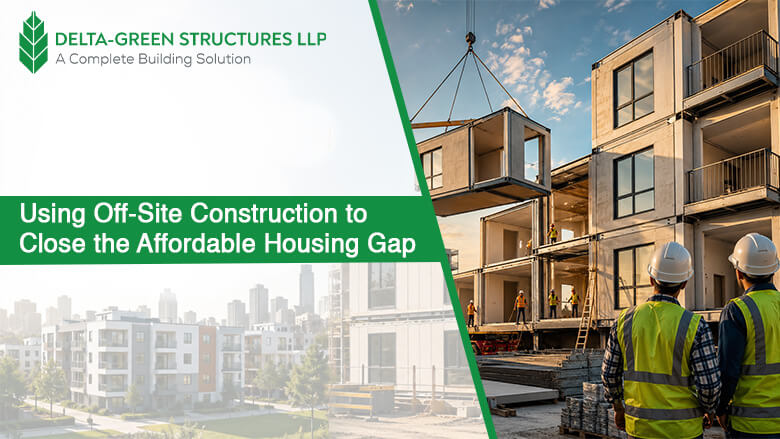
Using Off-Site Construction to Close the Affordable Housing Gap India’s affordable housing demand continues to outpace supply due to rapid urbanisation, rising land costs, labour shortages and increasing construction timelines. Conventional construction methods remain effective, but they often struggle to deliver large housing projects within increasingly demanding budgets and schedules. Off-site construction using Light Gauge Steel Frame (LGSF) technology offers a practical solution by shifting much of the construction process into a controlled manufacturing environment. This is why governments, developers, and others in the industry are turning toward Modern Methods of Construction (MMC) like Off-Site Construction for Affordable Housing – a smarter, faster, and more controlled way to build. What Exactly is Off-Site Construction? Off-site construction involves manufacturing structural components in a factory and assembling them at site. In LGSF construction, precision-engineered cold-formed steel sections are produced using CNC roll-forming machines, ensuring consistent quality, dimensional accuracy and rapid installation. This includes: Modular Construction Prefabricated Affordable Housing systems Factory-Built Homes Industrialized Construction techniques It is clean, efficient, and highly scalable. Why Off-Site Construction is the Perfect Fit for Affordable Housing Affordable housing needs three things: speed, cost control, and scalability. And that’s exactly where the Light Gauge Steel Framing system shines. 1. Faster Construction Without Compromising Quality With factory-built components, timelines shrink drastically. While traditional homes may take months or even years, Faster Construction using modular systems reduces that significantly. 2. Cost-Effective Housing That Actually Works One of the biggest benefits is predictability. Since everything is pre-engineered, there’s minimal waste and fewer unexpected expenses. This directly supports Cost-Effective Housing and Low-Cost Housing initiatives without compromising durability. 3. Reduced Construction Waste Factories operate with precision cutting and optimized material usage. That means significantly less waste compared to traditional on-site methods. This makes Sustainable Housing not just an idea but a practical reality. 4. Better Quality Control In a controlled factory setup, every module goes through strict quality checks. This leads to stronger structures and fewer defects compared to unpredictable site conditions. Modular Affordable Housing: The Future is Already Here Let’s talk about one of the most powerful outcomes of this system – Modular Affordable Housing. These are homes built in sections (modules), transported, and assembled on-site. They can be customized, expanded, or replicated at scale. This approach is redefining: Workforce Housing Social Housing Urban and rural housing development With Modular Construction, developers can respond quickly to demand spikes, especially in fast-growing regions. Sustainability Meets Speed: A Rare Combination Traditionally, speed and sustainability rarely went together in construction. But Light Gauge Steel Framing System’s factory-based production changes that equation. It enables: Energy-Efficient Homes Lower carbon footprint Less noise and site disruption Smarter resource utilization Where Delta Green Structures Comes In Delta Green Structures manufactures precision-engineered LGSF systems using automated Pinnacle roll-forming technology and BIM-based design workflows. From design and manufacturing to supply and turnkey execution, the company delivers high-quality off-site construction solutions across North-East India, including projects in challenging terrain. This is not just construction – it’s structured innovation at scale. Final Thoughts: Building Smarter Cities Starts Here As India continues investing in affordable housing, industrialised construction methods such as LGSF will play an increasingly important role in reducing project timelines, improving quality and delivering sustainable communities. Companies like Delta Green Structures are already showing how Factory-Built Homes and Modular Construction can reshape the housing landscape, especially in regions that need it most.

Using Off-Site Construction to Close the Affordable Housing Gap Read More »
Why Government Agencies Are Adopting Off-Site Construction

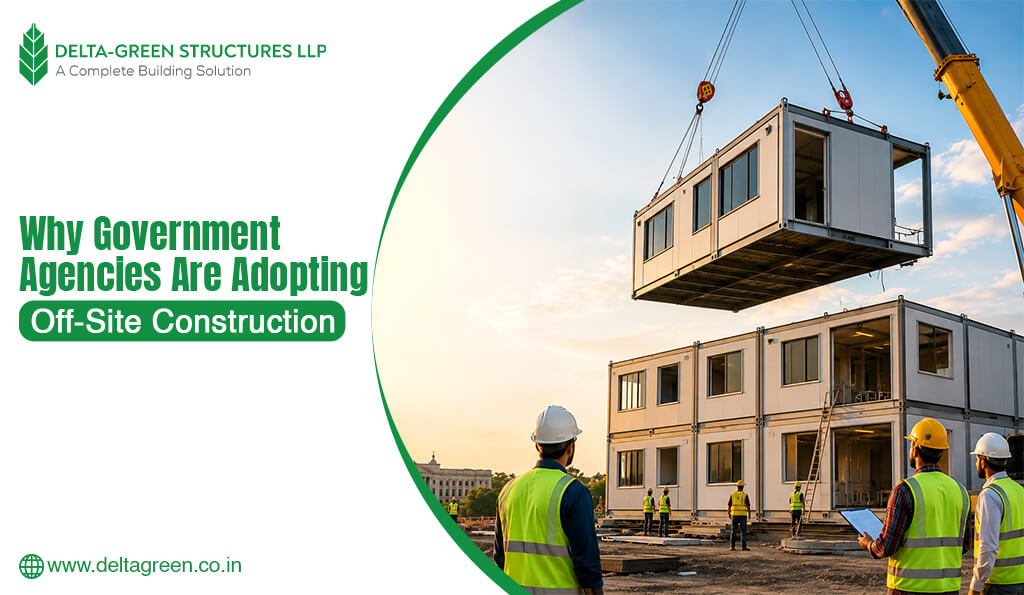
Why Government Agencies Are Adopting Off-Site Construction The Future of Public Infrastructure Is Being Built… Off-Site The way public infrastructure is designed and delivered is undergoing a significant transformation. Across India and around the world, government agencies are increasingly adopting off-site construction and other Modern Methods of Construction (MMC) to meet the growing demand for high-quality infrastructure within tighter timelines and budgets. With rapid urbanisation, expanding public infrastructure requirements, and increasing pressure to optimise public expenditure, conventional construction methods often struggle with labour shortages, weather-related delays, material wastage, and schedule overruns. As a result, governments are turning to industrialised construction systems that offer greater efficiency, consistency, and predictability. Off-site construction addresses these challenges by manufacturing structural components in a controlled factory environment before transporting them to the project site for assembly. This approach enables faster project execution, improved quality control, enhanced worker safety, and reduced environmental impact compared to conventional construction methods. Today, off-site construction is no longer considered an emerging trend-it is becoming an integral part of government construction projects, public infrastructure development, institutional buildings, and Smart City initiatives. Why Governments Are Moving Toward Modern Methods of Construction (MMC) Government departments are expected to deliver infrastructure that is durable, cost-effective, sustainable, and completed within strict project schedules. However, conventional construction methods are often affected by unpredictable site conditions, labour availability, weather disruptions, and inconsistent workmanship. Modern Methods of Construction (MMC), including Light Gauge Steel Frame (LGSF) systems, modular construction, prefabricated building systems, and other industrialised construction techniques, provide a practical solution to these challenges. By transferring a significant portion of the construction process to a controlled manufacturing facility, these systems ensure precision engineering, stringent quality control, and faster project execution. Factory-manufactured components are produced using automated processes and assembled on-site with minimal disruption, resulting in improved construction quality and greater schedule certainty. Companies such as Delta Green Structures are contributing to this transformation by manufacturing precision-engineered LGSF building systems using automated production technology. These solutions enable government agencies to deliver infrastructure more efficiently while maintaining high standards of quality, safety, and durability. Key Benefits Driving Government Adoption 1. Faster Project Delivery Without Compromising Quality One of the most significant advantages of off-site construction is its ability to reduce project timelines. Since component manufacturing and site development take place simultaneously, projects can be completed considerably faster than conventional construction methods. For government agencies, this enables the timely delivery of schools, hospitals, staff housing, healthcare centres, and other critical public infrastructure. 2. Cost-Effective Construction at Scale Cost efficiency is a key priority for public infrastructure projects. Off-site construction reduces material wastage, minimises labour dependency, improves productivity, and lowers the risk of costly project delays. These efficiencies contribute to better lifecycle value and more effective utilisation of public funds, particularly for large-scale and repetitive building programmes. 3. Sustainability & Green Building Advantage Sustainability has become a fundamental objective in modern infrastructure development. Factory-based manufacturing optimises material utilisation, significantly reduces construction waste, lowers site disturbances, and supports environmentally responsible construction practices. Combined with energy-efficient building design, off-site construction contributes to the development of greener and more sustainable public infrastructure. 4. High-Quality Buildings with Precision In controlled environments, materials are engineered with strict quality checks. This ensures High-Quality Buildings with better durability, accuracy, and performance compared to unpredictable traditional on-site construction. 5. Climate-Resilient Infrastructure From floods to earthquakes, infrastructure must withstand extreme conditions. Climate-Resilient Infrastructure built using modular systems ensures better structural integrity and long-term reliability. Off-Site vs. Traditional Construction: The Real Difference Off-site construction represents a significant evolution in the way buildings and infrastructure are planned, manufactured, and delivered. Unlike conventional construction, where most activities are carried out sequentially at the project site, off-site construction transfers a substantial portion of the work to a controlled manufacturing environment. Traditional construction methods are often affected by labour shortages, weather disruptions, material handling inefficiencies, and varying site conditions, all of which can impact project schedules, quality, and overall costs. In contrast, off-site construction enables structural components to be manufactured while site preparation progresses simultaneously. This parallel workflow significantly reduces construction time, improves quality control, minimises material wastage, and enhances project predictability. Modern off-site construction systems, including Light Gauge Steel Frame (LGSF) technology, offer precision-engineered components that are manufactured to stringent quality standards before being transported to site for rapid assembly. As a result, these systems are particularly well suited for government infrastructure projects that require speed, consistency, and scalability. As infrastructure demands continue to grow, the construction industry is steadily transitioning from labour-intensive site-based practices to manufacturing-led construction processes that deliver greater efficiency, quality, and reliability. Smart Cities & Public Infrastructure: The Big Push India’s rapid urbanisation and expanding infrastructure requirements have accelerated the need for construction methods that are faster, more sustainable, and capable of delivering consistent quality at scale. Initiatives such as the Smart Cities Mission, affordable housing programmes, institutional development, and urban infrastructure projects demand solutions that can be executed efficiently without compromising quality. Off-site construction is well positioned to address these requirements. From educational institutions and healthcare facilities to government offices, staff accommodation, public housing, and utility buildings, industrialised construction methods enable faster project delivery while reducing disruption to surrounding communities. By combining factory-based manufacturing with efficient on-site assembly, Modern Methods of Construction (MMC) improve productivity, minimise construction waste, and provide greater certainty in project delivery. These advantages make off-site construction an increasingly preferred approach for public infrastructure development across India. Where Delta Green Structures Fits Into This Transformation In this evolving ecosystem, Delta Green Structures is emerging as a strong enabler of industrialized construction in North-East India. With advanced LGSF technology, automated Pinnacle machines, and turnkey construction capabilities, the company is redefining how infrastructure is manufactured and delivered. Their approach to Off-Site Construction ensures precision-driven output, faster turnaround times, and scalable solutions for both private and government projects. What makes them stand out is their commitment to quality, climate adaptability, and end-to-end execution-making them highly relevant for modern Government Construction Projects and infrastructure needs in challenging terrains. By integrating innovation

Why Government Agencies Are Adopting Off-Site Construction Read More »