Delta Green

green building solutions

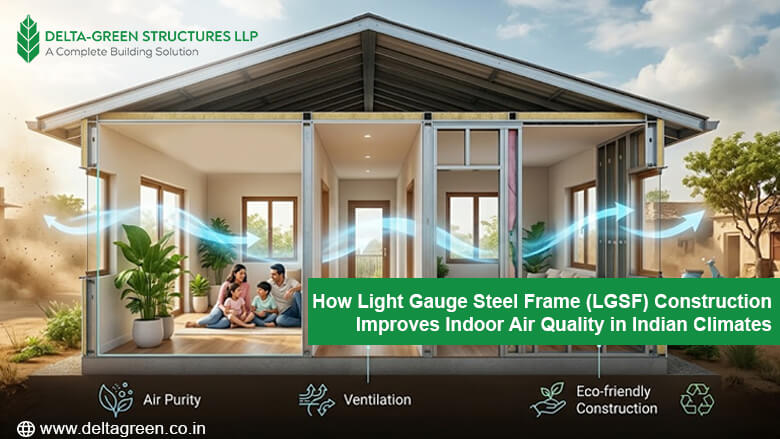
How Light Gauge Steel Frame (LGSF) Construction Improves Indoor Air Quality in Indian Climates

How Light Gauge Steel Frame (LGSF) Construction Improves Indoor Air Quality in Indian Climates Because the air you breathe inside your home should be as pure as your intentions behind building it. When we talk about construction in India, conversations usually revolve around cost, durability, and speed. But here’s a truth that’s often overlooked—the quality of indoor air directly affects your health, productivity, and overall well-being. With rising pollution levels, unpredictable weather patterns, and increasing urban density, indoor air quality has become a serious concern across Indian households and commercial spaces. This is exactly where Light Gauge Steel Frame Construction steps in—not just as a modern building method, but as a smarter, healthier way to build. Let’s break down how this innovative approach is transforming the way we breathe inside our spaces. The Invisible Problem: Indoor Air Quality in India From the humid air of the North-East to the dry heat of Rajasthan and the polluted metros like Delhi, Indian climates are diverse and challenging. Traditional construction methods often trap moisture, dust, and pollutants inside buildings. Common issues include: Mold growth due to damp walls Poor ventilation design Dust accumulation from porous materials Chemical emissions from low-quality construction inputs Over time, these factors contribute to respiratory problems, allergies, and fatigue. Now imagine a construction system designed to eliminate these problems from the ground up. What Makes Light Gauge Steel Frame Construction Different? Light Gauge Steel Frame Construction uses cold-formed steel sections to create the structural framework of a building. Unlike traditional brick-and-mortar systems, it is precise, factory-made, and engineered for performance. At companies like Delta Green Structures, this process is powered by advanced machinery and high-grade materials, ensuring consistency and quality in every project. But how does this relate to cleaner indoor air? Let’s take a closer look. 1. Zero Moisture Retention Means No Mold or Dampness One of the biggest enemies of indoor air quality is moisture. Traditional materials like bricks and cement tend to absorb water, especially in regions with heavy rainfall or humidity. With Lightweight steel construction, the structure itself does not absorb moisture. This means: No damp walls No hidden fungal growth No musty odors The result is a fresher and healthier indoor environment throughout the year. 2. Designed Ventilation, Not Accidental Airflow In conventional buildings, ventilation is often an afterthought. But with the LGSF building system, ventilation is integrated into the design stage itself. Using Modern steel frame construction, architects can: Plan precise airflow pathways Integrate mechanical ventilation systems seamlessly Optimize natural light and cross ventilation This ensures that fresh air circulates continuously, reducing indoor pollutants and improving oxygen levels. 3. Non-Toxic and Cleaner Building Materials Another hidden contributor to poor indoor air quality is the use of low-grade materials that release harmful chemicals over time. Steel stud framing construction eliminates this risk by using: High-quality galvanized steel Controlled, factory-manufactured components Minimal on-site chemical usage At Delta Green Structures, only top-tier materials and accessories are used, ensuring that your indoor space remains free from harmful emissions. 4. Dust-Free Precision Construction Traditional construction sites are often filled with cement dust, sand particles, and debris that linger even after completion. With Light gauge steel frame building technology, most components are pre-engineered and assembled with precision. This results in: Minimal dust generation Cleaner construction process Reduced post-construction contamination This means you move into a cleaner and healthier environment from day one. 5. Better Thermal Performance for Healthier Air Temperature plays a crucial role in indoor air quality. Poor insulation leads to: Excess humidity Condensation Increased pollutant concentration Light Gauge Steel Frame Construction allows for advanced insulation systems to be integrated within walls and roofs. This results in: Stable indoor temperatures Reduced humidity fluctuations Improved comfort and air quality In Indian climates, this makes a significant difference. 6. Adaptability across Indian Climates India’s climate diversity demands construction that adapts rather than resists. From the heavy rains of the North-East to coastal humidity and dry inland heat, Lightweight steel construction performs consistently across regions. Companies like Delta Green Structures, being one of the few advanced manufacturing units in the North-East, specialize in designing structures that respond intelligently to local environmental challenges. This ensures better indoor air quality regardless of location. 7. Airtight Yet Breathable Structures The best buildings are both airtight and breathable. With Modern steel frame construction, you get: Controlled air infiltration, preventing outside pollutants from entering Planned ventilation systems that ensure only clean air circulates This balance is essential for maintaining high indoor air quality while keeping external pollution out. 8. Faster Construction with Less Contamination The longer a construction project takes, the more exposure it has to dust, moisture, and environmental pollutants. Light Gauge Steel Frame Construction significantly reduces construction time due to: Pre-engineered components Automated manufacturing Efficient assembly At Delta Green Structures, the use of advanced Pinnacle machines ensures faster turnaround without compromising quality, resulting in cleaner and healthier buildings from the very beginning. Why This Matters More Than Ever Today, our indoor spaces do a lot more than just provide shelter. They function as workspaces, study areas, and safe zones for our families, which makes the quality of air inside them extremely important. With increasing pollution and changing lifestyles, poor indoor air can quietly impact health over time. That’s why choosing Light Gauge Steel Frame Construction is not just about structure—it’s about creating a cleaner, healthier living environment. It’s a smart, long-term investment in comfort, well-being, and better everyday living. Final Thoughts: Build Smart, Breathe Better Indoor air quality is not something that can be fixed later. It must be built into the structure from the very beginning. With its precision engineering, moisture resistance, cleaner materials, and smart ventilation, Light Gauge Steel Frame Construction offers a clear advantage over traditional methods. With a reliable partner like Delta Green Structures, you are not just building faster or more efficiently—you are building healthier. Because a truly modern building does not just stand strong, it creates a space where you can breathe freely every single day.

How Light Gauge Steel Frame (LGSF) Construction Improves Indoor Air Quality in Indian Climates Read More »

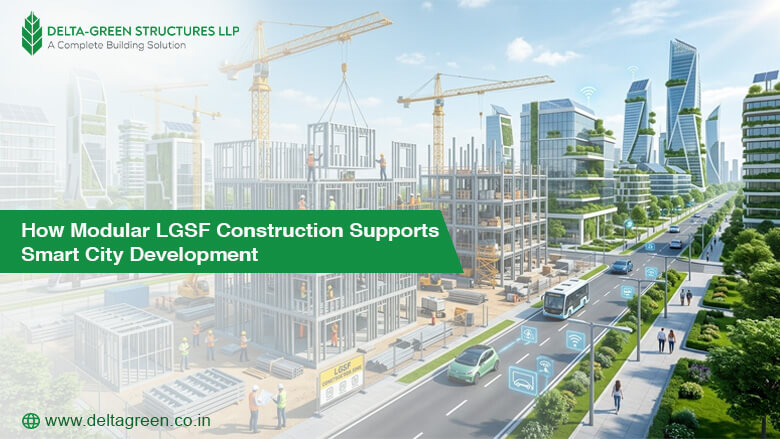
How Modular LGSF Construction Supports Smart City Development

How Modular LGSF Construction Supports Smart City Development Cities today are growing at a pace never seen before. Populations are expanding, infrastructure needs are multiplying, and governments around the world are working toward a shared vision — smart cities that are efficient, sustainable, and future-ready. But building a smart city is not just about digital technology or connected systems. It begins with how the city itself is constructed. Traditional construction methods often struggle with delays, rising costs, and environmental impact. This is exactly where Modular LGSF Construction for Smart City Development is changing the game. Using advanced LGSF construction technology, developers can now build faster, smarter, and more sustainably than ever before. And companies like Delta Green Structures are helping lead this transformation by introducing precision-engineered Lightweight Steel Frame construction solutions designed for modern urban needs. The Construction Challenge Behind Smart Cities Every smart city project aims to create infrastructure that improves quality of life. From residential buildings and commercial hubs to hospitals and educational institutions, everything must be built efficiently, sustainably, and at scale. However, conventional construction often faces common challenges: Long project timelines Weather disruptions High material wastage Increased labour dependency Limited flexibility in design These challenges slow down Smart city infrastructure development, making it harder for cities to keep up with growing urban demands. This is why planners are increasingly turning toward modular construction in smart cities — a modern building approach that prioritizes efficiency, sustainability, and precision. What is Modular LGSF Construction? At its core, Modular LGSF Construction for Smart City Development combines the strength of steel with the efficiency of prefabrication. In Lightweight Steel Frame construction, buildings are created using cold-formed galvalume steel sections. These sections are manufactured with advanced automated machines, ensuring high accuracy and consistent quality. Instead of building everything on-site, structural components are pre-engineered and prefabricated in controlled environments. They are then transported to the site and assembled quickly. This process introduces a smarter way of building cities using Prefabricated steel structures and Fast-track construction technology. With its advanced manufacturing facility and automated Pinnacle machines, Delta Green Structures offers end-to-end LGSF solutions, making large-scale projects faster and more reliable. Speed That Matches the Growth of Modern Cities One of the biggest advantages of Modular LGSF Construction for Smart City Development is speed. Urban development projects often require quick completion to support growing populations. Waiting years for housing or infrastructure can slow economic development. This is where Fast-track construction technology plays a vital role. Since structural components are manufactured off-site, on-site construction becomes significantly faster. Projects that traditionally take over a year can often be completed in 40–60% less time using Modular construction in smart cities. This speed is especially beneficial for: Modern urban housing solutions Commercial complexes Educational institutions Healthcare infrastructure Faster construction not only saves time but also accelerates Smart urban planning solutions, helping cities expand without delays. Sustainability: The Foundation of Smart Urban Development A truly smart city is also a sustainable city. Environmental responsibility is becoming one of the most important aspects of urban development. Governments and developers now prioritize Sustainable construction for smart cities to reduce carbon footprints and environmental impact. LGSF construction technology naturally supports this vision. Here’s how: Reduced Construction Waste Traditional construction generates large amounts of debris and leftover materials. In contrast, prefabricated steel structures are produced with high precision, minimizing waste. Eco-Friendly Materials Steel used in Lightweight Steel Frame construction is recyclable, making it a core component of Eco-friendly construction technology. Energy-Efficient Buildings Modern LGSF designs support Energy-efficient building systems, improving insulation and reducing energy consumption in urban buildings. These advantages make Green building solutions more accessible and practical for large-scale smart city projects. Through innovation and engineering expertise, Delta Green Structures is helping clients implement environmentally responsible infrastructure across diverse geographic conditions. Strength and Safety for Future Cities Smart cities must be designed to withstand environmental challenges and natural disasters. One of the standout advantages of LGSF construction technology is its structural resilience. Steel frames distribute loads more efficiently than traditional concrete structures. This makes them highly reliable as Earthquake-resistant building technology, especially in regions prone to seismic activity. Additional benefits include: High structural accuracy Long-lasting durability Resistance to moisture and pests Lightweight yet strong framework These qualities make Modular LGSF Construction for Smart City Development ideal for long-term urban infrastructure projects. Cost Efficiency for Rapid Urban Expansion Building smarter cities should not mean dramatically increasing costs. Urban planners constantly search for Cost-effective urban construction solutions that balance quality and affordability. Modular LGSF Construction for Smart City Development significantly reduces construction costs through: Faster project completion Lower labour dependency Minimal material wastage Reduced maintenance requirements Because components are manufactured with automated precision, developers gain better control over project budgets. With customizable packages and complete construction support, Delta Green Structures helps clients implement scalable Modern urban housing solutions while maintaining financial efficiency. LGSF vs Traditional Construction for Smart Cities The shift from traditional building techniques to modular steel systems highlights the Role of modular construction in smart city projects. Factor Traditional Construction LGSF Construction Construction Time Slow Fast-track construction technology Environmental Impact High material waste Eco-friendly construction technology Structural Accuracy Moderate High precision Seismic Safety Moderate Earthquake-resistant building technology Energy Efficiency Limited Energy-efficient building systems This comparison clearly demonstrates how LGSF construction supports sustainable urban development. For rapidly expanding cities, Modular LGSF Construction for Smart City Development provides the efficiency, resilience, and sustainability required to support future growth. The Role of Modular Construction in Smart City Projects The Role of modular construction in smart city projects goes far beyond faster buildings. It enables cities to create infrastructure that is: Scalable Sustainable Technologically adaptable Economically viable As urban populations continue to grow, Modular LGSF Construction for Smart City Development provides the flexibility required to build infrastructure quickly while maintaining environmental responsibility. With advanced manufacturing and engineering expertise, Delta Green Structures is contributing to a new era of Smart city infrastructure development across India. Building the Cities of Tomorrow — Today Smart cities are not just

How Modular LGSF Construction Supports Smart City Development Read More »

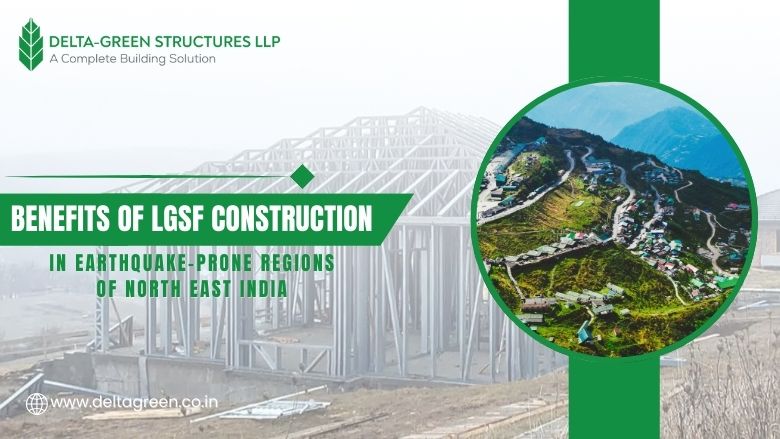
Benefits of LGSF Construction in Earthquake-Prone Regions of North East India

The Earthquake Reality in North East India North East India faces a critical reality: it’s one of the most earthquake-prone regions in the country. Seismic Zones IV and V cover Assam, Manipur, Meghalaya, Arunachal Pradesh, Sikkim, and other North-East states. Zone V is the highest risk category. Zone IV still carries a significant seismic threat. Recently the entire Northeastern region of India along with the broader Himalayan belt has been shifted to the newly created Zone VI by the Bureau of Indian Standards, under the 2025 Earthquake Design Code (IS 1893:2025). For decades, most buildings in these regions have been built using traditional RCC (Reinforced Concrete) and brick masonry. These structures are rigid and brittle. When earthquakes strike, they crack, collapse, and fail catastrophically. The result? Loss of life. Damaged property. Communities rebuilding from rubble. But modern construction technology offers a different approach: Light Gauge Steel Framing (LGSF). Unlike rigid concrete, LGSF is flexible, lightweight, and designed specifically to absorb seismic forces without breaking. Buildings built with LGSF don’t collapse in earthquakes. They flex, absorb energy, and protect occupants. This is why LGSF is becoming the preferred technology for earthquake-resistant construction across North East India.   Why North East India Needs Earthquake-Resistant Construction The statistics are sobering. North East India experiences frequent earthquakes: 1987 Manipur earthquake: 4.3 magnitude2004 Assam earthquake: 4.5 magnitude2009 Assam earthquake: 5.1 magnitude2011 Sikkim earthquake: 6.9 magnitude (devastating) These aren’t isolated events. They’re regular. Recurring. Predictable. Yet most homes, schools, hospitals, and offices in the North East are built with traditional methods that fail during earthquakes. The question isn’t whether an earthquake will hit North East India. It’s when. And when it does, will the building protect people or harm them? LGSF construction answers that question with proof. How LGSF Outperforms Traditional RCC in Earthquakes Reason 1: Lightweight Means Lower Seismic Forces The Physics: During an earthquake, force equals mass times acceleration (F = MA). Heavier buildings experience greater seismic forces. LGSF buildings are 40-60% lighter than equivalent RCC structures. This dramatically reduces the force an earthquake exerts on the building. Real Impact: A building weighing half as much experiences roughly half the seismic force. On a ₹20 crore multi-story project, this difference becomes the difference between safety and collapse. Reason 2: Steel is Flexible, Concrete is Brittle The Critical Difference: RCC is strong but brittle. It resists force rigidly. When force exceeds its strength, it cracks and fails suddenly. Steel, by contrast, is ductile. It bends without breaking. During an earthquake, LGSF buildings sway and flex, absorbing seismic energy instead of fighting it. Research Proof: Studies comparing RCC and steel frame structures in earthquake zones show steel structures exhibit: Lower lateral displacements (less sway) Reduced base shear (less force on foundation) Enhanced ductility (can bend significantly without breaking) Greater energy dissipation (absorbs earthquake force safely) Reason 3: Superior Strength-to-Weight Ratio Steel has the highest strength-to-weight ratio of any building material. This means: Maximum structural capacity with minimum weight. In earthquake zones, this is the holy grail of structural design. Real Outcome: LGSF buildings can support the same loads as heavier RCC structures while remaining lighter, more flexible, and more seismically resistant. Reason 4: Engineered Connections & Bracing Systems LGSF structures include: Diagonal bracing systems that distribute seismic forces evenly Shear walls that increase lateral stiffness Reinforced connections designed to withstand lateral movement Advanced fastening techniques that keep components securely together during earthquakes Every connection is engineered for seismic performance, not just architectural aesthetics. Reason 5: Uniform Load Distribution RCC concentrates loads at specific points (columns, walls). If these fail, the entire building fails. LGSF distributes loads evenly throughout the steel frame structure. If one component fails, the structure redistributes loads and maintains integrity. Safety Implication: LGSF structures don’t have single points of failure during earthquakes. LGSF vs RCC: The Practical Comparison Factor RCC LGSF Building Weight 40-50% heavier 40-60% lighter Flexibility Rigid (brittle) Flexible (ductile) Seismic Force Resistance Fights rigidly Absorbs energy Lateral Displacement Higher (more sway) Lower (controlled sway) Base Shear on Foundation Higher Lower Ductility (bending capacity) Low High Post-earthquake Repair Extensive (cracks/damage) Minimal (design absorbs energy) Construction Time 18-24 months 6-9 months Cost in Seismic Zones Higher (extra reinforcement) Comparable or lower Real-World Evidence: LGSF in Earthquake Zones Japan: Uses LGSF extensively. Frequent earthquakes demonstrate LGSF’s superior safety and quick recovery. New Zealand: After the devastating Christchurch earthquake (2011), LGSF construction was chosen for reconstruction because of its proven resilience. Turkey & Iran: Following major earthquakes, LGSF has been increasingly adopted for post-disaster reconstruction. North East India: Delta Green Structures builds LGSF structures designed specifically for High seismic conditions. Five Key Benefits of LGSF in North East India 1. Lives Are Protected LGSF buildings don’t collapse. They flex, absorb energy, and remain standing. People survive. 2. Property Damage is Minimized Unlike RCC buildings that develop extensive cracks and damage, LGSF buildings experience minimal post-earthquake damage because they absorb rather than fight seismic forces. 3. Faster Recovery LGSF buildings require minimal repairs after earthquakes. Communities recover faster. Economic impact is lower. 4. Government Compliance   LGSF construction complies with IS 1893:2016 (Indian seismic design standards) and exceeds minimum requirements in seismic zones. 5. Long-Term Durability Galvanized steel used in LGSF resists corrosion in North East India’s humid climate. Buildings stay strong for 50+ years with minimal maintenance. FAQ: LGSF Construction in Earthquake-Prone North East Q: Is LGSF really safer than RCC in earthquakes? A: Yes. Research shows steel structures outperform RCC structures in seismic zones through lower weight, higher ductility, and better energy dissipation. Q: Can LGSF handle Zone VI earthquakes (the highest seismic zone)? A: Yes. LGSF structures are engineered for specific seismic zones and can be designed for Zone VI compliance when properly engineered. Q: Is LGSF construction legal in North East India? A: Absolutely. LGSF complies with IS 1893:2016, IS 4326:2013, and all Indian Building Codes. It’s approved for seismic zones. Q: Does LGSF cost more than RCC in seismic zones? A: No. While LGSF components may cost slightly more, total project

Benefits of LGSF Construction in Earthquake-Prone Regions of North East India Read More »