
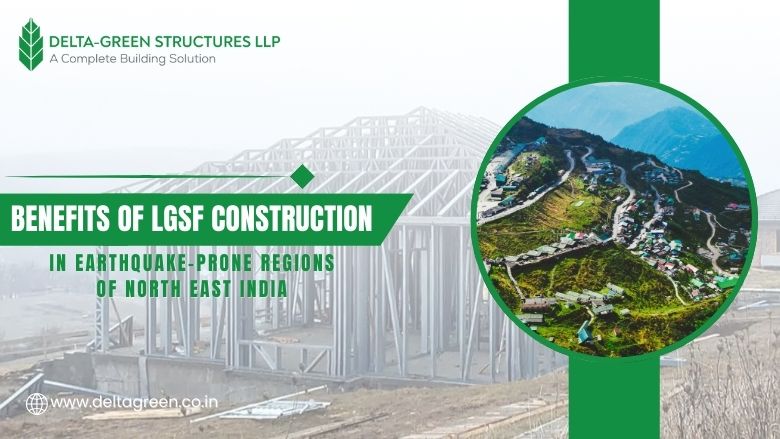
The Earthquake Reality in North East India
North East India faces a critical reality: it’s one of the most earthquake-prone regions in the country.
Seismic Zones IV and V cover Assam, Manipur, Meghalaya, Arunachal Pradesh, Sikkim, and other North-East states. Zone V is the highest risk category. Zone IV still carries a significant seismic threat. Recently the entire Northeastern region of India along with the broader Himalayan belt has been shifted to the newly created Zone VI by the Bureau of Indian Standards, under the 2025 Earthquake Design Code (IS 1893:2025).
For decades, most buildings in these regions have been built using traditional RCC (Reinforced Concrete) and brick masonry. These structures are rigid and brittle. When earthquakes strike, they crack, collapse, and fail catastrophically.
The result? Loss of life. Damaged property. Communities rebuilding from rubble.
But modern construction technology offers a different approach: Light Gauge Steel Framing (LGSF).
Unlike rigid concrete, LGSF is flexible, lightweight, and designed specifically to absorb seismic forces without breaking. Buildings built with LGSF don’t collapse in earthquakes. They flex, absorb energy, and protect occupants.
This is why LGSF is becoming the preferred technology for earthquake-resistant construction across North East India.
Why North East India Needs Earthquake-Resistant Construction
The statistics are sobering. North East India experiences frequent earthquakes:
1987 Manipur earthquake: 4.3 magnitude
2004 Assam earthquake: 4.5 magnitude
2009 Assam earthquake: 5.1 magnitude
2011 Sikkim earthquake: 6.9 magnitude (devastating)
These aren’t isolated events. They’re regular. Recurring. Predictable.
Yet most homes, schools, hospitals, and offices in the North East are built with traditional methods that fail during earthquakes.
The question isn’t whether an earthquake will hit North East India. It’s when. And when it does, will the building protect people or harm them?
LGSF construction answers that question with proof.
How LGSF Outperforms Traditional RCC in Earthquakes
Reason 1: Lightweight Means Lower Seismic Forces
The Physics: During an earthquake, force equals mass times acceleration (F = MA). Heavier buildings experience greater seismic forces.
LGSF buildings are 40-60% lighter than equivalent RCC structures. This dramatically reduces the force an earthquake exerts on the building.
Real Impact: A building weighing half as much experiences roughly half the seismic force. On a ₹20 crore multi-story project, this difference becomes the difference between safety and collapse.
Reason 2: Steel is Flexible, Concrete is Brittle
The Critical Difference: RCC is strong but brittle. It resists force rigidly. When force exceeds its strength, it cracks and fails suddenly.
Steel, by contrast, is ductile. It bends without breaking. During an earthquake, LGSF buildings sway and flex, absorbing seismic energy instead of fighting it.
Research Proof: Studies comparing RCC and steel frame structures in earthquake zones show steel structures exhibit:
- Lower lateral displacements (less sway)
- Reduced base shear (less force on foundation)
- Enhanced ductility (can bend significantly without breaking)
- Greater energy dissipation (absorbs earthquake force safely)
Reason 3: Superior Strength-to-Weight Ratio
Steel has the highest strength-to-weight ratio of any building material. This means:
Maximum structural capacity with minimum weight. In earthquake zones, this is the holy grail of structural design.
Real Outcome: LGSF buildings can support the same loads as heavier RCC structures while remaining lighter, more flexible, and more seismically resistant.
Reason 4: Engineered Connections & Bracing Systems
LGSF structures include:
- Diagonal bracing systems that distribute seismic forces evenly
- Shear walls that increase lateral stiffness
- Reinforced connections designed to withstand lateral movement
- Advanced fastening techniques that keep components securely together during earthquakes
Every connection is engineered for seismic performance, not just architectural aesthetics.
Reason 5: Uniform Load Distribution
RCC concentrates loads at specific points (columns, walls). If these fail, the entire building fails.
LGSF distributes loads evenly throughout the steel frame structure. If one component fails, the structure redistributes loads and maintains integrity.
Safety Implication: LGSF structures don’t have single points of failure during earthquakes.
LGSF vs RCC: The Practical Comparison
Factor | RCC | LGSF |
Building Weight | 40-50% heavier | 40-60% lighter |
Flexibility | Rigid (brittle) | Flexible (ductile) |
Seismic Force Resistance | Fights rigidly | Absorbs energy |
Lateral Displacement | Higher (more sway) | Lower (controlled sway) |
Base Shear on Foundation | Higher | Lower |
Ductility (bending capacity) | Low | High |
Post-earthquake Repair | Extensive (cracks/damage) | Minimal (design absorbs energy) |
Construction Time | 18-24 months | 6-9 months |
Cost in Seismic Zones | Higher (extra reinforcement) | Comparable or lower |
Real-World Evidence: LGSF in Earthquake Zones
Japan: Uses LGSF extensively. Frequent earthquakes demonstrate LGSF’s superior safety and quick recovery.
New Zealand: After the devastating Christchurch earthquake (2011), LGSF construction was chosen for reconstruction because of its proven resilience.
Turkey & Iran: Following major earthquakes, LGSF has been increasingly adopted for post-disaster reconstruction.
North East India: Delta Green Structures builds LGSF structures designed specifically for High seismic conditions.
Five Key Benefits of LGSF in North East India
1. Lives Are Protected
LGSF buildings don’t collapse. They flex, absorb energy, and remain standing. People survive.
2. Property Damage is Minimized
Unlike RCC buildings that develop extensive cracks and damage, LGSF buildings experience minimal post-earthquake damage because they absorb rather than fight seismic forces.
3. Faster Recovery
LGSF buildings require minimal repairs after earthquakes. Communities recover faster. Economic impact is lower.
4. Government Compliance
LGSF construction complies with IS 1893:2016 (Indian seismic design standards) and exceeds minimum requirements in seismic zones.
5. Long-Term Durability
Galvanized steel used in LGSF resists corrosion in North East India’s humid climate. Buildings stay strong for 50+ years with minimal maintenance.
FAQ: LGSF Construction in Earthquake-Prone North East
Q: Is LGSF really safer than RCC in earthquakes?
Q: Can LGSF handle Zone VI earthquakes (the highest seismic zone)?
Q: Is LGSF construction legal in North East India?
Q: Does LGSF cost more than RCC in seismic zones?
Q: Can I retrofit existing RCC buildings with LGSF technology?
Q: How does LGSF perform in heavy monsoon regions like Meghalaya?
Q: Is LGSF fire-resistant?
Q: Why don't all North East buildings use LGSF?
Conclusion: The Future of North East Construction is LGSF
North East India faces real earthquake risk. Traditional RCC and brick masonry construction have proven inadequate.
LGSF represents a fundamental shift: from rigid structures that fight earthquakes to flexible structures that absorb them.
The evidence is overwhelming. Research confirms it. Real-world performance in Japan, New Zealand, and globally proves it. And now, Delta Green Structures brings this proven technology specifically to North East India.
When the next earthquake hits—and it will—buildings constructed with LGSF will protect people. RCC buildings may fail.
The choice is clear. The technology is proven. The time to build smarter is now.
For earthquake-prone North East India, LGSF construction isn’t an option. It’s the responsibility we owe to communities, families, and future generations.