
Over the last several years, the construction sector has moved far beyond conventional building practices. What was once a space dominated by manual planning, heavy labour, and long project cycles is now shaped by intelligent tools and high-precision manufacturing. One of the biggest contributors to this shift is LGSF manufacturing (Light Gauge Steel Framing), a system that brings speed, accuracy, and long-term strength into a single framework.
As digital fabrication, automation, and Building Information Modeling (BIM) become more widely adopted, LGSF is evolving into an even more advanced construction solution. At Delta Green Structures, where fully automated Pinnacle machines and next-generation LGSF technology form the core of our processes, we’ve seen firsthand how these innovations are redefining the way buildings are designed and delivered especially in challenging climates and terrains across India.
Technology’s Growing Role in Modern LGSF Manufacturing
LGSF manufacturing goes far beyond producing steel frames. It is a complete structural approach that relies on accuracy, speed, and engineered performance. Today, advanced LGSF design software converts architectural ideas into detailed, error-free structural models. These digital models are then sent directly to automated roll-forming machines, eliminating inconsistencies that were once common in manual production.
In earlier years, fabricators relied heavily on manual calculations and physical drafting. This led to delays, misalignments, and high material wastage. With the adoption of automation, the scenario has completely changed. Technology now ensures:
- Precise material utilization with nearly zero wastage
- Greater accuracy in steel components
- Reduced labour dependency without compromising quality
- Shorter turnaround time from design to execution
This integration of design, automation, and quality control is what allows Delta Green Structures to deliver LGSF components that are both highly accurate and cost-efficient, helping clients get better and faster results.
BIM: The Digital Backbone of Smarter Construction
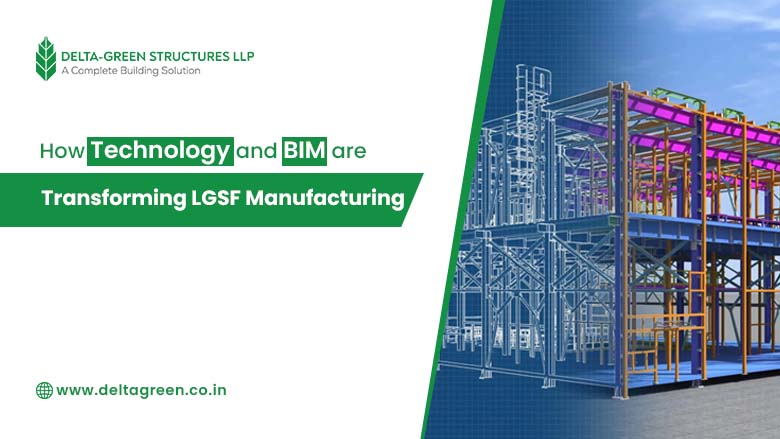
The introduction of Building Information Modeling (BIM) has been one of the most transformative developments in construction. Unlike traditional 2D drawings, BIM creates a detailed 3D representation of the entire building—including its structure, services, joints, and connections.
For LGSF manufacturing, this digital environment brings immense clarity and removes guesswork from the process.
How BIM Improves the LGSF Workflow
- Early Detection of Errors
BIM makes it easy to identify design clashes and structural conflicts before manufacturing begins. For an engineered system like LGSF, this is crucial because it ensures proper load paths and smooth structural alignment.
- Clear Visualization for All Stakeholders
Clients, engineers, architects, and contractors get a clear view of the building long before the first frame is produced. This reduces communication gaps and helps decision-making happen faster.
- Accurate Material Estimation
Since BIM models are data-driven, they calculate steel weight, accessories, and fixing requirements precisely. This leads to predictable project costs and avoids sudden material shortages.
- Direct Integration with Automated Machines
One of the greatest advantages of BIM is its ability to feed digital data directly into automated Pinnacle machines. This removes manual intervention and ensures each LGSF member is fabricated exactly as designed.
Why BIM and LGSF Are an Ideal Combination
When BIM and LGSF technology come together, the result is a highly efficient, coordinated, and scalable construction system. This combination is especially valuable for projects that demand speed and precision.
- Faster and More Streamlined Execution
LGSF structures are already quick to assemble, but with BIM-based planning, site teams receive perfectly coordinated components that fit together without rework. This drastically reduces construction time.
- Accuracy Beyond Conventional Methods
LGSF requires millimetre-level precision. Because BIM is data-rich and model-driven, it ensures that every stud, truss, joist, and frame is placed accurately, maintaining structural reliability throughout the building.
- Cost Savings at Multiple Stages
The integration of BIM with LGSF leads to lower rework, accurate steel calculation, optimized labour use, and faster completion, all of which contribute to significant cost reduction.
- Reliable Solutions for Complex Terrains
Whether it’s hilly regions, high-rainfall areas, or remote construction sites, LGSF paired with BIM provides a lightweight, durable, and transport-friendly building system. Digital planning ensures proper analysis of geographical challenges before fabrication starts.
Technological Innovations Strengthening the LGSF Industry
- Fully Automated Roll-Forming Systems
At Delta Green Structures, Pinnacle machines convert digital files into cold-formed steel profiles with consistent speed and precision. This minimizes human error and ensures uniformity across all components.
- Next-Generation Structural Engineering Software
Modern software platforms often integrated with BIM, evaluate wind pressure, building loads, seismic conditions, and other structural factors, ensuring long-term performance and safety.
- Digital Inspection and Quality Assurance
With tech-enabled monitoring tools, teams can check alignment, dimensions, and joinery quality at every stage. It helps maintain high-quality standards across the full LGSF manufacturing cycle.
- Real-Time Project Management Tools
From approvals and design updates to fabrication timelines and delivery tracking, digital systems create transparency and keep every stakeholder informed.
How Delta Green Structures Is Driving This Transformation
As the only LGSF manufacturing unit in North-East India offering complete turnkey solutions, Delta Green Structures places innovation and precision at the centre of every project. Our approach includes:
- Using premium LGSF materials and accessories
- Implementing BIM-based workflows for maximum accuracy
- Offering customisable and flexible project packages
- Managing complex terrains and climates with expert engineering
- Ensuring fast delivery without compromising quality
Our goal is to build structures that are future-ready—strong, sustainable, and designed with technological excellence.
Conclusion
The combination of advanced technology and BIM has taken LGSF manufacturing to a new level of efficiency and reliability. What once required extensive manual effort can now be executed with remarkable speed and precision. From enabling accurate fabrication to improving project coordination and reducing construction costs, these technologies are shaping the next era of building.
At Delta Green Structures, we remain committed to adopting the highest-quality LGSF technology and BIM tools to deliver world-class construction solutions. As the industry continues to evolve, the integration of digital design and automated manufacturing will play a crucial role in shaping the buildings of tomorrow and we are proud to be part of that transformation.